Updated October 2026. This guide reflects NRS Chapters 116 and 116A as amended by the 83rd Legislature (2025), including AB 10, AB 396, SB 201 and SB 440, and Fannie Mae's 2026 condo reserve changes. It also covers LCB File No. R091-25, a 2026 Commission regulation that would change how the 5-year reserve study cycle is measured and how reserve studies define adequate funding. The 2025 session did not change the reserve study cycle or the reserve funding rules in NRS 116.31152 and 116.3115. This is a plain-language summary, not legal advice. Confirm your association's obligations with Nevada counsel.
If you are an HOA board member, property manager, or reserve specialist operating in Nevada, you need to know this: Nevada has one of the country's most specific and strictly enforced laws regarding community association reserves. Compliance is not optional—it’s a mandatory fiduciary duty established in the Nevada Revised Statutes (NRS) Chapter 116.
This guide breaks down exactly what is required, how often it must be done, and the key compliance steps needed to protect your community.
What's Changed in Nevada HOA Law (2025–2026)
The 2025 legislative session did not change the 5-year reserve study cycle, the annual board review, the 30-year projection, or the board's power to levy reserve assessments without an owner vote. It did pass four laws that touch common-interest communities, plus a change to the association insurance statute. Three took effect in 2025 and the main HOA provisions of AB 396 took effect July 1, 2026.
| Law | What changed | Why it matters for reserves |
|---|---|---|
| AB 396: housing and HOA changes (NRS 116.2117, 116.2118, 116.31065, 116.335, 116.4109, 116.785) | Associations may reasonably restrict leasing to meet lender or insurer standards. Resale packages must now include proof of the insurance policies the association is required to carry under NRS 116.3113. The maximum administrative fine the Commission can impose rose from $1,000 to $5,000 per violation. The bill also amended the termination statute (NRS 116.2118) and requires large counties and cities to authorize accessory dwelling units. Effective July 1, 2026 for the HOA provisions. | Buyers, lenders and insurers now see insurance proof in the resale package, and leasing limits tied to lender rules help owners keep conventional financing. Higher fines raise the cost of non-compliance for boards and managers. |
| SB 440: rooftop solar (NRS 116.333, 116.334) | Associations must decide on an owner's solar request within 35 days if they have solar rules, or 15 days if they do not, or the request is deemed approved. Association rules may not raise installation costs by more than 3%. Effective June 5, 2025 and October 1, 2025. | Solar arrays on roofs the association maintains can change roof replacement planning. Add them to the component inventory at the next study update. |
| SB 201: religious and cultural items (NRS 116.323) | Associations and landlords may not ban a resident from displaying religious or cultural items on doors and doorframes, within size and safety limits. The prevailing party can recover attorney's fees. Effective July 1, 2025. | No direct effect on reserves. Boards should update their rules, since conflicting rules are void. |
| AB 10: water and sewer repairs (NRS 271.147) | Counties and cities may include repairs to association-owned water or sewer systems in neighborhood improvement projects, funded by bonds repaid through assessments on each property. Owners cannot halt these districts by protest. Effective immediately. | If a private sewer or water system fails and is not funded, a local government can step in and the cost lands on owners through long-term assessments. A funded reserve avoids that outcome. |
| Insurance statute (NRS 116.3113) | The 2025 session added a provision for wildfire. An association's property policy that covers wildfire and coordinates with owners' individual wildfire policies is not required to include the units. The association must still meet the statute's other insurance requirements. | Insurance deductibles and coverage gaps are a common reason boards draw on reserves. Review coverage and deductible exposure when you update the funding plan. |
New in 2026: Reserve Study Regulation R091-25 (Pending)
The Commission for Common-Interest Communities and Condominium Hotels has been working since late 2025 on LCB File No. R091-25, a package of changes to NAC Chapters 116 and 116A. The second revised draft (July 1, 2026) adds three changes to the reserve study rules. The Commission held its adoption hearing on September 9, 2026. A Nevada regulation takes effect only after the Legislative Commission approves it and it is filed with the Secretary of State. As of late October 2026, no adopted version has been filed in the Legislature's regulation register. Until then, the current NAC rules still apply.
| Rule | Current NAC | Under R091-25 |
|---|---|---|
| 5-year cycle (NAC 116.427) | The 5-year period starts on the date of the on-site inspection of major components and ends when the board adopts the study. The next full study must start by the same month and day as the previous inspection. | The 5-year period starts on the first day of the association's fiscal year in which the full study is adopted. The board must adopt a new full study during the fifth fiscal year, within 210 days of receiving the results or before budgets are prepared and distributed under NRS 116.31151, whichever comes first. The adoption must be recorded in the meeting minutes. |
| Funding plan terms (NAC 116.425) | The study's funding plan statement must discuss full funding, threshold funding and baseline funding, where applicable. | Baseline funding is removed. The study discusses full funding and threshold funding only. |
| "Adequately funded reserves" (NAC 116.425) | Funds sufficient to maintain the common elements at the level in the latest study, without using operating funds or special assessments, except for unforeseen catastrophic events. | Funds that are continuously sufficient, and the projected reserve balance may never reach zero or less at any point in the 30-year projection. |
What it means for boards: A funding plan that lets the reserve balance dip to zero in some future year, which is the core of baseline funding, would no longer count as adequate funding in Nevada. Associations funding near baseline should ask their Reserve Study Specialist for a threshold or full funding plan before the next budget. Boards should also match their study schedule to the fiscal year and record each adoption vote in the minutes. The same regulation sets criteria for health, safety and welfare fines, raises the state mediation subsidy to $600, and sets rules for handing over association records when a management company changes.
What has not changed in the statute: NRS 116.31152 still requires a reserve study at least once every 5 years by a registered Reserve Study Specialist, an annual review of the results, and a summary filed with the Real Estate Division within 45 days of adoption. NRS 116.3115 still requires the board to fund adequate reserves and lets it impose the assessments needed without an owner vote. Nevada has no statutory reserve funding percentage and no structural inspection mandate like those in Florida, California or New Jersey.
Is a Nevada HOA Reserve Study Required? The Short Answer is YES.
In Nevada, reserve studies are mandatory for virtually all Common-Interest Communities (CICs), which include most Homeowners Associations (HOAs) and Condominium Associations (COAs). The law doesn't offer easy exemptions based on community size or age—if your association is responsible for common area elements, you are generally subject to the rules.
The goal of the law is clear: associations must maintain "adequate reserves". Legally, this means having enough funds to repair, replace, and restore major common elements without having to use operating funds or resort to a special assessment for components already identified in the study.
The 5-Year Onsite Cycle and Annual Review
Nevada law establishes a critical dual cadence for reserve planning:
1. The Full Onsite Study: Every 5 Years
The executive board shall commission a comprehensive study of the reserves at least once every 5 years .
Under the current regulation (NAC 116.427), the 5-year compliance clock restarts on the date that the on-site, visual inspection of major components is performed. Pending regulation R091-25 would instead tie the cycle to the association's fiscal year (see above). This means simply updating the financial data remotely (often called a Level III update) is
not sufficient to meet the 5-year mandate. The study must incorporate a physical inspection of components such as roofs, roads, HVAC, and building structures to legally reset the cycle.
2. The Annual Fiduciary Duty
Regardless of the 5-year cycle, the board has an annual responsibility:
- The board must review the most recent study annually to ensure the reserves are sufficient .
- The board must adjust required contributions (assessments) if necessary, factoring in current inflation and interest rates to keep the plan accurate.
Boards must also review the reserve account revenues and expenses, comparing them to the budget, at least once every quarter during an executive board meeting.
Who Can Perform the Reserve Study? Registration and Insurance Mandates
Nevada is unique because it regulates the profession. The person preparing your study cannot be just anyone; they must meet specific professional and financial requirements.
Mandatory Registration (RSS)
Except for limited statutory exceptions, the person who conducts the reserve study must be a registered Reserve Study Specialist (RSS) with the Nevada Real Estate Division (NRED) .
To qualify, the RSS must demonstrate specific competence in evaluating component deterioration, useful life, current costs, and the ability to perform the necessary financial analysis, including the mandatory 30-year projection.
The $1 Million Insurance Requirement
A key protection for associations: the registered RSS must maintain professional liability insurance or a surety bond with minimum coverage of $1,000,000. This high minimum acts as a financial safeguard for the association and owners in case professional negligence leads to a grossly inaccurate or deficient study.
Conflicts of Interest
The RSS must disclose in writing any actual, potential, or perceived conflict of interest that they have with the association or any related parties (like vendors) . This ensures the specialist remains independent and objective.
What Must Be in the Reserve Study Report?
The law prescribes specific content to ensure accuracy and transparency:
- 30-Year Projection: The study must include a financial analysis covering a minimum of a 30-year projection of capital expenditures and funding.
- Component Inventory: A detailed assessment of all major common area components the association is responsible for maintaining, repairing, or replacing.
- Financial Assumptions: The report must explicitly disclose the source and rates used for interest and inflation rate assumptions in the projection . This allows the board and owners to evaluate if the funding plan is based on realistic economic forecasts.
- Source Data: The method used for determining component lives and replacement costs, based on industry data, must be documented .
Reserve Funding and Strict Usage Rules
Nevada imposes clear rules on how reserve funds are established and spent:
Using Reserve Funds: Only for Reserves
Reserve funds may be used only for the purposes identified in the reserve study—which means repairing, replacing, or restoring major components (e.g., roofs, roads, sidewalks) .
They must not be used for daily maintenance . Misusing reserve funds to cover operating shortfalls is a serious breach of fiduciary duty and must be explicitly disclosed in the annual budget.
Choosing a Funding Plan
Nevada sets no minimum funding percentage, but the reserve study must explain its funding plan using the standard industry terms. Today those are full, threshold and baseline funding. Under pending regulation R091-25, baseline funding drops out and "adequately funded reserves" means a projected balance that never reaches zero at any point in the 30-year projection. Funding toward a threshold or full funding goal is the safer choice, both for Nevada compliance and for Fannie Mae's reserve study alternative.
Board Authority to Levy Special Assessments
To maintain "adequate reserves" , the executive board has the authority to impose a reasonable
special assessment against units for a set period, provided that assessment is explicitly based on the findings of the reserve study. This power is designed to ensure financial health quickly, even without a unit owner vote, if the objective data from the study requires it.
Disclosure, Penalties, and External Risk
Nevada's compliance framework is backed by specific administrative penalties and affects property marketability.
Reporting to the State (NRED)
The board must submit a summary of the adopted reserve study to the Nevada Real Estate Division (NRED) not later than 45 days after the executive board formally adopts the results of the study .
Financial Penalties for Disclosure Failure
Boards that fail to provide required documents (including the budget or reserve study) to owners upon request within the required timeframe risk administrative action. The Commission may impose a penalty of $25 for each day the records were not provided timely.
Impact on Financing (Fannie Mae/Freddie Mac)
Compliance with NRS 116 is crucial for property values. Major lenders, like Fannie Mae, often allow a compliant reserve study to be used in lieu of the standard replacement reserve requirement (10% of assessment income, rising to 15% for loan applications dated on or after January 4, 2027) for project eligibility, provided the budget funds the study's highest recommended contribution. If the association's 5-year study is expired or deemed inadequate, it can severely restrict a unit owner's ability to finance or refinance their home .
Fannie Mae's New 15% Reserve Rule (Lender Letter LL-2026-03)
This is a federal lending rule, not a Nevada law, but it decides whether buyers of condominium units in Nevada can get conventional financing. Fannie Mae issued Lender Letter LL-2026-03 on March 18, 2026, and Freddie Mac made matching changes.
- 15% reserve minimum. For loan applications dated on or after January 4, 2027, the association's budget must allocate at least 15% of assessment income to replacement reserves, up from the long-standing 10%.
- A stricter reserve study alternative. An association below the minimum can still qualify with a reserve study completed or updated within the past three years, but only if its budget funds the study's highest recommended contribution. Baseline funding is no longer accepted.
- Full project reviews. For loan applications dated on or after August 3, 2026, lenders can no longer use the streamlined Limited Review, so most condo loans now get a full review of the budget and reserves.
Boards that want owners to keep access to conventional financing should plan to budget at least 15% of assessment income for reserves, or fund the highest plan in a current reserve study. Read more: New Fannie Mae & Freddie Mac Rules Are Coming. Is Your Community Ready?
What’s Next? The Legislative Horizon
Nevada's Legislature meets in regular session only in odd-numbered years, so the next regular session is February 2027. Proposals to require reserve studies annually instead of every five years have been floated before, including SB 56, and none has become law. Treat the current 5-year cycle as the legal minimum, not a best practice, and expect reserve rules in other states and Fannie Mae's 15% reserve minimum to keep the topic active. SmartProperty will update this guide if a Nevada reserve bill advances.
Two regulatory tracks are also in motion. Regulation R091-25 (above) is awaiting Legislative Commission approval. Separately, under Governor Lombardo's Executive Order 2026-003, the Real Estate Division is reviewing its regulations and held a stakeholder meeting on NAC Chapters 116, 116A and 116B on October 8, 2026. That review could lead to further changes to the reserve study and reserve specialist rules.
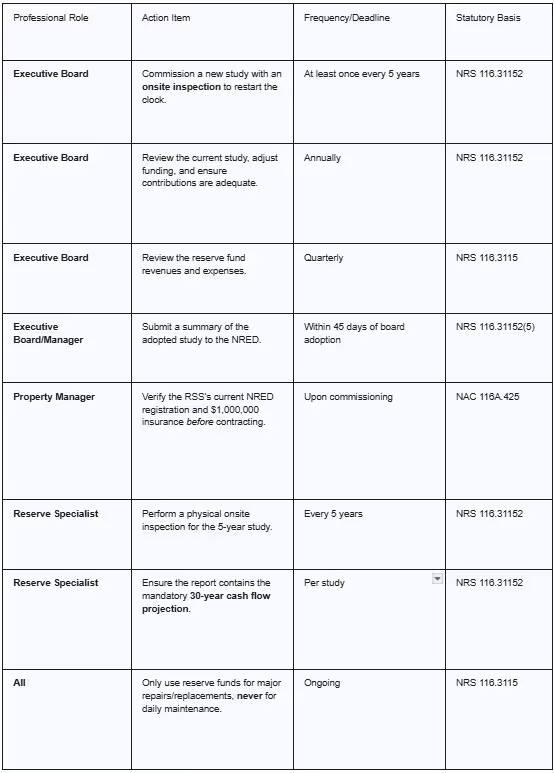
Action Plan: Your Compliance Checklist
Nevada Reserve Law FAQ
Did the 2025 Nevada legislative session change the reserve study requirement?
No. NRS 116.31152 still requires a study at least once every 5 years and an annual board review, and NRS 116.3115 still requires adequate reserves. The 2025 laws that affect associations deal with leasing, resale packages, fines, solar, religious displays, water and sewer repairs, and wildfire insurance.
How much can the Commission fine for a violation of NRS 116 now?
Up to $5,000 per violation, raised from $1,000 by AB 396. The change took effect July 1, 2026.
What must a Nevada resale package show about insurance?
Since July 1, 2026, the resale package must include proof of the insurance policies the association is required to carry under NRS 116.3113, in addition to the budget, reserve study summary and fee disclosures already required.
Can a Nevada HOA board raise assessments for reserves without an owner vote?
Yes. Under NRS 116.3115, the executive board may impose necessary and reasonable assessments to establish adequate reserves without owner approval, provided they are based on the reserve study.
Does Fannie Mae's 15% reserve rule apply in Nevada?
Yes, for condominium projects. For loan applications dated on or after January 4, 2027, the association's budget must allocate at least 15% of assessment income to reserves, or fund the highest recommended contribution in a reserve study completed or updated within three years.
Is Nevada changing its reserve study rules in 2026?
Through regulation, not statute. LCB File No. R091-25 would measure the 5-year cycle by fiscal year, require adoption within 210 days of receiving the study and in the meeting minutes, remove baseline funding, and define adequate reserves as a projected balance that never reaches zero. The Commission held its adoption hearing on September 9, 2026. The rule takes effect only after Legislative Commission approval.
Is baseline funding still allowed in Nevada?
Under current NAC 116.425, a study may still discuss baseline funding. Pending regulation R091-25 removes it and requires that the projected reserve balance never reach zero, which baseline plans are designed to approach. Boards funding near baseline should plan to move to a threshold or full funding goal.
Sources
- Nevada Revised Statutes, Chapter 116 (Common-Interest Ownership)
- 2025 Statutes of Nevada, Chapter 365 (AB 396)
- Nevada Real Estate Division, 83rd Legislative Session overview of CIC bills (AB 10, AB 396, SB 201, SB 440)
- Second Revised Proposed Regulation, LCB File No. R091-25 (July 1, 2026)
- Nevada Real Estate Division, Notice of Hearing for Adoption of R091-25 (September 9, 2026)
- Nevada Administrative Code, Chapter 116
- Nevada Real Estate Division, Public Hearings per Executive Order 2026-003
- Fannie Mae Lender Letter LL-2026-03 (March 18, 2026)
Last updated:
Not legal advice. This guide is general information about reserve requirements and is not a legal recommendation. Laws and lender rules change, and how they apply depends on your association's governing documents and circumstances. For the most up-to-date requirements, check your state's official website or consult an HOA attorney.