For Tennessee condominium associations (COAs), the rules around preparing for major capital repairs have changed significantly. Driven by structural safety concerns nationwide, the Volunteer State has adopted mandatory, periodic reserve studies for its shared-structure communities.
1. Is a Reserve Study Required or Recommended in Tennessee?
Answer: Required, but only for certain communities.
The reserve study requirement is mandatory for qualifying Unit Owners’ Associations (Condominiums) under the Tennessee Condominium Act of 2008 (TCA § 66-27-403(g)).
Who Must Comply?
This specific mandate applies to Condominium Associations (COAs) that oversee common elements with an aggregate replacement cost exceeding $10,000. Since this threshold is extremely low, it encompasses virtually all Tennessee condominiums with shared roofs, foundations, systems, or amenities.
Who Is Exempt?
The law explicitly does not apply to
- Traditional single-family Homeowners Associations (HOAs) or Planned Communities (these are governed by separate, less comprehensive statutes).4
- Associations still controlled by the Declarant (developer).
- Condominiums titled to a single owner.
- Condominiums owned by a husband and wife as a tenancy by the entirety.
2. Key Compliance Deadlines and Frequency
The Tennessee law mandates a specific cycle for both initial studies and subsequent updates, ensuring associations maintain a current understanding of their financial health.
Initial Study Deadline
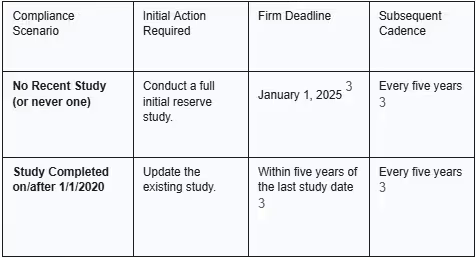
The critical date for many associations is January 1, 2025.
- If your COA has NOT completed a reserve study on or after January 1, 2020, you must have a full reserve study completed on or before January 1, 2025.
The Ongoing 5-Year Cadence
Once a study has been completed (either before or by the January 2025 deadline), the association must have it updated at least every five (5) years thereafter.
Annual Review: Beyond the five-year physical cycle, the board is required to annually review the reserve study to consider and implement necessary adjustments in their budget.
3. Study Methodology: What is Required?
The Tennessee law dictates a rigorous standard for the analysis, focusing on preventative maintenance and structural safety.
Mandatory Standards
All studies and updates must conform to the latest edition of the Reserve Study Standards published by the Community Associations Institute (CAI), or similar standards recognized nationally.
Onsite Inspection vs. Update (Levels)
To meet the legal requirement of "assessing the condition of and planning for repair and maintenance of the common elements" , the study must include two parts:
- Physical Analysis (Onsite): This involves an onsite inspection of the common elements, quantifying them, assessing their condition, and estimating their remaining useful life (RUL).
- Financial Analysis: This determines the annual contributions necessary to adequately fund future repairs and replacements.
Given the emphasis on elements critical to structural integrity and safety, the initial study by the 2025 deadline should be a
Level I Full Reserve Study. Subsequent five-year updates typically require, at minimum, a Level II Update with Site Visit to verify the physical condition of major components.
Required Content
The report must identify the major components the association is responsible for repairing or replacing. This specifically includes items critical to structural integrity, such as: roofs, fire protection systems, plumbing and electrical systems, exterior cladding, balconies, and elevators.
4. Who May Perform the Reserve Study?
To ensure professional quality and objectivity, Tennessee law strictly limits who may conduct the mandatory reserve study. The professional must be a third party and must be one of the following :
- A Reserve Specialist who is credentialed through the Community Associations Institute (CAI) or a similarly recognized national organization.
- A licensed Professional Engineer (P.E.).
- A licensed Architect.
5. Funding and Financial Governance: The Tennessee Paradox
This is a critical area of nuance for Tennessee COAs:
Mandatory Study, Optional Funding
While the study is mandatory, Tennessee statute does not mandate a minimum reserve funding level.2 The law requires the study to inform the board and owners of the amount that
should be maintained to minimize special assessments.
Important: Just because the state law doesn't force a minimum funding percentage, your association’s own Declaration or Bylaws may impose specific funding requirements. Boards should always prioritize their governing documents.
The Real Driver: Fannie Mae and Freddie Mac
The most significant de facto funding requirement comes from the mortgage lending market. If your association wants unit owners to be able to easily secure conventional financing, you must generally adhere to lender guidelines.
Fannie Mae, for example, requires either:
- A budget that allocates at least 10% of assessment income to replacement reserves, rising to 15% for loan applications dated on or after January 4, 2027, OR
- A reserve study completed or updated within the past three years, with a budget that funds the study's highest recommended contribution. Baseline funding is no longer accepted.
Fannie Mae's New 15% Reserve Rule (Lender Letter LL-2026-03)
This is a federal lending rule, not a Tennessee law, but it decides whether buyers of condominium units in Tennessee can get conventional financing. Fannie Mae issued Lender Letter LL-2026-03 on March 18, 2026, and Freddie Mac made matching changes.
- 15% reserve minimum. For loan applications dated on or after January 4, 2027, the association's budget must allocate at least 15% of assessment income to replacement reserves, up from the long-standing 10%.
- A stricter reserve study alternative. An association below the minimum can still qualify with a reserve study completed or updated within the past three years, but only if its budget funds the study's highest recommended contribution. Baseline funding is no longer accepted.
- Full project reviews. For loan applications dated on or after August 3, 2026, lenders can no longer use the streamlined Limited Review, so most condo loans now get a full review of the budget and reserves.
Boards that want owners to keep access to conventional financing should plan to budget at least 15% of assessment income for reserves, or fund the highest plan in a current reserve study. Read more: New Fannie Mae & Freddie Mac Rules Are Coming. Is Your Community Ready?
Ignoring the funding recommendations of a required reserve study can severely impact the marketability and value of units in your community.
Restrictions on Borrowing from Reserves
The Tennessee Condominium Act does not specify state-level restrictions on temporarily borrowing from reserve funds for operating expenses. Any such restrictions or rules must be found in the association's governing Declaration or Bylaws.
6. Disclosure, Duties, and Risks
Owner Disclosure is Mandatory
The board is legally required to make a copy of the completed reserve study available to all common interest owners. This must be done promptly via electronic mail or by posting it on the community website.
Board Risk and Liability
The failure to commission or update the mandatory reserve study by the statutory deadlines is a clear breach of the Tennessee Condominium Act. While the state does not impose administrative fines for non-compliance, the primary risk is exposure to
civil litigation.
Board members elected by unit owners are required to exercise ordinary and reasonable care in their duties.3 Failing to follow a clear state mandate, especially one designed to ensure structural safety and financial stability, can constitute a breach of this duty, potentially exposing the board and the association to legal action.
Intersections with Other Laws
The reserve study serves as the primary mechanism for documentation regarding structural integrity and financial planning. Tennessee does not currently impose a separate, broad structural integrity inspection law for existing condominiums. Therefore, rigorous adherence to the reserve study mandate is the best defense against claims of negligence related to deferred maintenance.
Forthcoming Changes: Watch the HOA Act
While COAs have clear reserve requirements, traditional single-family HOAs are largely unregulated in Tennessee. Legislative efforts to pass a comprehensive Tennessee Homeowners Association Act are frequently introduced. Boards and managers should continuously monitor the Tennessee General Assembly, as the passage of a new HOA Act could extend mandatory reserve study or funding requirements to Planned Communities.
Last updated:
Not legal advice. This guide is general information about reserve requirements and is not a legal recommendation. Laws and lender rules change, and how they apply depends on your association's governing documents and circumstances. For the most up-to-date requirements, check your state's official website or consult an HOA attorney.