If you manage or serve on the board of a Virginia Homeowners' Association (HOA) or Condominium Association (COA), you must comply with mandatory reserve study requirements.
Virginia's law treats reserve funding as a non-negotiable component of financial health. Compliance is not optional; it’s mandated by the Virginia Property Owners' Association Act (POAA) and the Virginia Condominium Act (VCA).
This guide breaks down exactly what your association needs to know right now, from the mandatory schedule to the recent, powerful legislative changes of 2024 (HB 1209) that impact your authority and liability.
1. Is a Reserve Study Required in Virginia? (The Binary Answer)
Yes, Reserve Studies are mandatory in Virginia.
Unlike some states where a study is merely recommended, Virginia law requires most common interest communities (CICs)—including HOAs (POAs) and Condos (COAs)—to commission a study.1
Core Compliance Cadence: The 5-Year Rule
The law establishes a clear, recurring schedule for every association:
- Conduct a Full Study: You must commission a complete study at least once every five years to determine the necessary amount of reserves required to repair, replace, and restore capital components .
- Annual Review: The board or executive board must review the results of that most recent 5-year study at least annually to confirm that the existing reserve funds are sufficient.1
- Annual Adjustment: Based on the annual review, the board must implement any necessary adjustments to the annual budget and assessment rate to ensure reserves are maintained "as appropriate".1
2. What Must the Reserve Study Cover? (Physical Status & Methodology)
The state legislature, through 2024 legislation (HB 1209), formally defined what a reserve study must accomplish, clarifying the scope for both POAs and COAs.
The Legal Definition of a Reserve Study (Effective July 1, 2024)
A "Reserve study" is legally defined as a capital budget planning tool used to determine the physical status and estimated repair or replacement cost of capital components, along with an analysis of the association's funding capacity.
Key Takeaway: The "Physical Status" Requirement
While Virginia law currently does not explicitly mandate a professional onsite inspection (often called a Level I or II study) , the new requirement to determine the component’s "physical status" makes relying solely on a financial, offsite update (Level III) risky.
To fulfill fiduciary duties and adhere to industry standards—especially for components like roofs, structural elements, or paving—a physical, onsite assessment by a qualified professional is the only reliable way to accurately determine remaining useful life (RUL) and current replacement cost (CRC) .
The Mandatory 5-Point Budget Disclosure
Virginia requires exceptional financial transparency. If your reserve study shows a need to budget for reserves, your association’s annual budget document must include five specific, line-item disclosures :
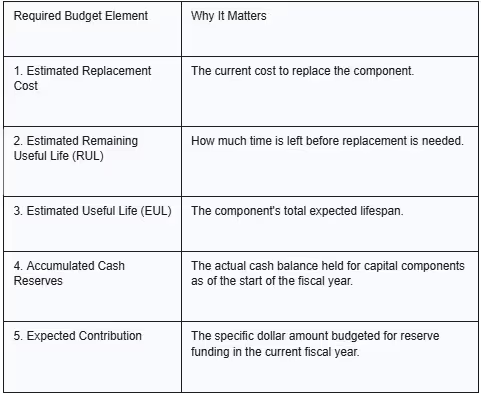
Property managers must ensure these five data points, derived directly from the study, are included in every annual budget package.
3. Who is Qualified to Perform the Study? (Licensing and Independence)
Current Virginia law does not explicitly require licensing, certification, or third-party independence for the person conducting the reserve study.
This statutory silence means, technically, the study could be done internally by a board member or a property manager.
However, this is not recommended.
In the absence of state-mandated licensing, liability rests heavily on the board. The best way to demonstrate due diligence and mitigate risk is to engage an independent, professionally certified Reserve Specialist (RS).
The Future of Qualifications: What’s on the Horizon?
Legislative focus is shifting. A 2022 mandate (Senate Bill 740) required the Department of Professional and Occupational Regulation (DPOR) to study the adequacy of current laws, specifically including the "qualification of persons conducting such studies".
This DPOR study signals that mandatory certification or licensing requirements for reserve specialists are highly likely legislative changes in the coming years.
4. The 2024 Power Shift: Critical New Laws (HB 1209)
The 2024 General Assembly session resulted in powerful new legislation (House Bill 1209, Chapter 324) that significantly changes how Virginia boards can address reserve shortfalls. These changes took effect on July 1, 2024.
The new law places maximum authority and responsibility for financial stability directly on the board.
Key Changes from HB 1209
1. Removal of the Owner Assessment Veto
Old Rule: Owners previously had a statutory right to rescind or reduce "additional assessments" (formerly "special assessments") within 60 days of notice .
New Rule: That statutory right has been removed for any additional assessment levied primarily for the maintenance, repair, and replacement of capital components .
Impact: Boards can now mandate necessary assessment increases derived from the reserve study to fund critical capital projects without fear of political veto, ensuring assets do not deteriorate due to chronic underfunding.
2. Explicit Borrowing Authority
The law now explicitly grants boards the authority to:
- Borrow funds for the purpose of "funding recommended reserves" and for the maintenance and replacement of structural components.
- Pledge assessment revenue (both annual and additional) to secure the repayment of any such loan.
Impact: This gives boards a clear, statutory mechanism to quickly close major funding gaps identified by the reserve study, protecting the community from deferred maintenance risks .
5. Non-Compliance Risks: Penalties and Liability
Failing to meet the mandatory 5-year study cycle or neglecting the required annual review and adjustment exposes the association to significant risk .
- Legal Action: Non-compliance is grounds for a lawsuit to recover damages or seek injunctive relief. This action can be maintained by the association itself, or by one or more aggrieved lot owners (individually or as a class action) .
- Attorney Fees: The prevailing party in such litigation is entitled to recover reasonable attorney fees and costs .
- Director Liability: While Virginia statutes protect volunteer directors from personal liability unless they engage in "willful misconduct" , the mandatory nature of the reserve study requirement means that a board’s deliberate failure to commission a required study or address severe, disclosed underfunding could potentially lead to a claim of willful misconduct, especially if major damage or financial harm results .
- Lender Eligibility: Fannie Mae and Freddie Mac require associations to demonstrate adequate reserves for project eligibility. Non-compliance with the reserve study’s funding recommendations can lead to a denial of project approval, making it difficult for owners to secure conventional mortgage financing .
Fannie Mae's New 15% Reserve Rule (Lender Letter LL-2026-03)
This is a federal lending rule, not a Virginia law, but it decides whether buyers of condominium units in Virginia can get conventional financing. Fannie Mae issued Lender Letter LL-2026-03 on March 18, 2026, and Freddie Mac made matching changes.
- 15% reserve minimum. For loan applications dated on or after January 4, 2027, the association's budget must allocate at least 15% of assessment income to replacement reserves, up from the long-standing 10%.
- A stricter reserve study alternative. An association below the minimum can still qualify with a reserve study completed or updated within the past three years, but only if its budget funds the study's highest recommended contribution. Baseline funding is no longer accepted.
- Full project reviews. For loan applications dated on or after August 3, 2026, lenders can no longer use the streamlined Limited Review, so most condo loans now get a full review of the budget and reserves.
Boards that want owners to keep access to conventional financing should plan to budget at least 15% of assessment income for reserves, or fund the highest plan in a current reserve study. Read more: New Fannie Mae & Freddie Mac Rules Are Coming. Is Your Community Ready?
6. Action Checklist for Boards and Managers
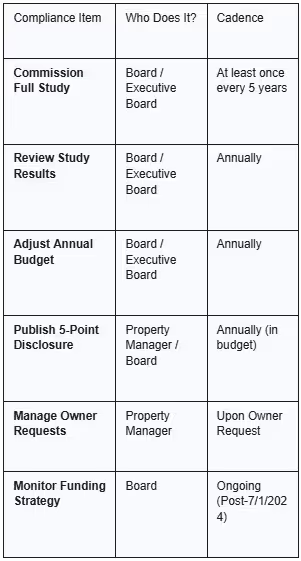
Last updated:
Not legal advice. This guide is general information about reserve requirements and is not a legal recommendation. Laws and lender rules change, and how they apply depends on your association's governing documents and circumstances. For the most up-to-date requirements, check your state's official website or consult an HOA attorney.