For HOA and Condominium boards in Washington State, a reserve study is not a suggestion—it is a clear legal mandate. Understanding the law is the critical first step to securing your community’s financial health, preventing massive special assessments, and protecting property marketability.
1. Is a Reserve Study Legally Required in Washington? (Binary + Nuance)
The Answer is Yes. Washington State requires that most residential common interest communities (CICs)—including condominiums and homeowners' associations—prepare and maintain a reserve study.1
- Condos (RCW 64.34) and HOAs (RCW 64.38): Associations with "significant assets" are required to prepare and update a study unless doing so would impose an "unreasonable hardship".1 Because these terms are not clearly defined in the statute, relying on them for exemption is a significant risk.1
- Small Association Waiver: A limited exception exists for condominiums with ten or fewer units. These associations can waive the study requirement, but only if two-thirds of the unit owners agree, and this vote must be renewed every three years.1 Even if waived, the lack of a study
must be disclosed on all resale certificates.1 - New or Transitioning Communities (WUCIOA/RCW 64.90): Newer communities, or those governed by the Washington Uniform Common Interest Ownership Act (WUCIOA), are strictly mandated to maintain a study unless they are restricted to nonresidential use, have nominal reserve costs, or if the study cost exceeds 10% of the annual budget.1
2. The Compliance Cadence: How Often Must You Inspect?
Washington law demands a rigorous, two-part schedule that ensures both the financial projections and the physical data remain accurate.2
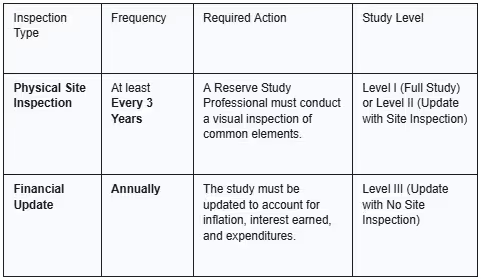
This structure ensures your financial planning is constantly monitored, but the physical assumptions (lifespan and cost) are rigorously re-verified on a 36-month cycle.
3. Who Can Perform the Reserve Study? (Independence is Key)
The qualifications for the preparer are defined by statute, but market demands often set a higher standard for financial safety.
- Definition of a Professional: A "Reserve Study Professional" is an independent person suitably qualified by knowledge, skill, and experience.State licensing is not legally required.
- The Independence Rule: The initial study and the triennial site inspections must be performed by a professional. If the study is prepared internally, it must be reviewed by an independent party at least every three years.
- Property Manager Status: A managing agent who holds industry reserve study designations is not considered a conflict of interest for the purposes of conducting this triennial independent review.
4. Required Content: The 1% Rule and Funding Plans
Washington law is highly prescriptive about what must be included in your report (RCW 64.38.070).
A. Component Inclusion (The 1% Rule)
The study must include a list of all reserve components—from roofing and paving to decks and siding—whose cost for major maintenance or replacement would exceed one percent (1%) of the association's annual budget (excluding the reserve contribution itself). If a component that meets this threshold is excluded, the professional must provide commentary explaining the rationale.
B. Mandatory Funding Plan Presentation
To equip the board with planning options, the report must present three distinct funding strategies :
- Full Funding Plan: The contribution rate required to achieve 100% funding status by the end of the 30-year study period.
- Baseline Funding Plan: The contribution rate needed to ensure the reserve balance never drops below zero throughout the 30-year period (a high-risk option).
- Recommended Contribution Rate: The specific rate recommended by the Reserve Study Professional.
C. Required Disclosures to Owners
Every reserve study must include a specific statutory disclosure :
"This reserve study should be reviewed carefully. It may not include all common and limited common element components that will require major maintenance, repair, or replacement in future years... The failure to include a component in a reserve study, or to provide contributions to a reserve account for a component, may, under some circumstances, require you to pay on demand as a special assessment your share of common expenses...".
5. Funding and Borrowing Restrictions
While Washington law encourages associations to establish a reserve account , it does
not mandate a specific funding percentage (e.g., 70% funded).4 However, the law is strict on how reserve funds can be used (RCW 64.90.540).
- Borrowing for Operational/Non-Reserve Costs: If the board withdraws funds for unforeseen or unbudgeted operational costs (unrelated to replacement), the withdrawal must be recorded in the minutes, owners must be notified, and the board must adopt a mandatory repayment schedule not to exceed 24 months.
- Borrowing for Unbudgeted Replacement: Funds can be withdrawn to pay for unexpected replacement costs of reserve components not included in the current study without the 24-month repayment restriction.
6. Forthcoming Changes: The Critical 2028 Deadline
The single most important legislative change on the horizon is the expiration of key exemptions for Homeowners' Associations.
- The Sunset Date: Exemptions under RCW 64.38 (which include the small association rule and the 5% cost-to-budget exemption) will expire on January 1, 2028.
- The Impact: After this date, nearly all residential HOAs will be governed by the stricter, standardized requirements of WUCIOA (RCW 64.90.545).1 Boards currently relying on older exemptions should immediately begin the mandatory triennial inspection cadence to ensure compliance.
7. Practical Concerns: Why Compliance Protects Your Property Value
While the state’s statutory civil penalty for willful non-compliance is relatively small (up to $1,000 to an owner) , the true danger lies in property marketability.
- Lender Compliance is Key: Fannie Mae and Freddie Mac require associations to maintain project eligibility for conventional financing. To do this, they demand a current reserve study or update completed within three years of a loan approval date.
- The Lender Reserve Minimum: Lenders require the association to budget a minimum of 10% of annual assessments for reserves, rising to 15% for loan applications dated on or after January 4, 2027.11 If you wish to budget a lower amount, the
only way to secure an exemption and maintain project eligibility is with a current reserve study prepared by an independent third party that justifies the lower rate.
Fannie Mae's New 15% Reserve Rule (Lender Letter LL-2026-03)
This is a federal lending rule, not a Washington law, but it decides whether buyers of condominium units in Washington can get conventional financing. Fannie Mae issued Lender Letter LL-2026-03 on March 18, 2026, and Freddie Mac made matching changes.
- 15% reserve minimum. For loan applications dated on or after January 4, 2027, the association's budget must allocate at least 15% of assessment income to replacement reserves, up from the long-standing 10%.
- A stricter reserve study alternative. An association below the minimum can still qualify with a reserve study completed or updated within the past three years, but only if its budget funds the study's highest recommended contribution. Baseline funding is no longer accepted.
- Full project reviews. For loan applications dated on or after August 3, 2026, lenders can no longer use the streamlined Limited Review, so most condo loans now get a full review of the budget and reserves.
Boards that want owners to keep access to conventional financing should plan to budget at least 15% of assessment income for reserves, or fund the highest plan in a current reserve study. Read more: New Fannie Mae & Freddie Mac Rules Are Coming. Is Your Community Ready?
In short: To protect your community's marketability and financial stability, you must adhere to the higher standard of a triennial independent third-party site inspection and ensure your funding policy is supported by the professional’s recommendations.
Last updated:
Not legal advice. This guide is general information about reserve requirements and is not a legal recommendation. Laws and lender rules change, and how they apply depends on your association's governing documents and circumstances. For the most up-to-date requirements, check your state's official website or consult an HOA attorney.