The legal situation in South Dakota is straightforward: South Dakota state law does not explicitly require condo associations or HOAs to conduct reserve studies or maintain a minimum reserve fund balance. There is no specific statutory guidance or requirement regarding reserve studies or funding in the state. While associations typically have the power under their governing documents or state nonprofit corporation law (most South Dakota HOAs are nonprofits) to establish budgets and collect assessments, there is no state law mandating how reserves must be handled.
This absence of a state mandate is often misinterpreted as a "pass" on reserve planning. This is a critical—and potentially costly—misunderstanding. In South Dakota, the lack of specific state rules elevates the importance of the board's general fiduciary duty.
What is a South Dakota HOA board's fiduciary duty? This legal standard requires board members to act in "good faith," with loyalty, and with the care an "ordinarily prudent person" would exercise in similar circumstances. This includes making informed decisions and exercising prudent financial management regarding the association's assets.
This creates a paradox: the lack of a specific law requiring a study makes having one even more important in South Dakota. Why? Because if a major component fails (like a roof, road, or shared facility) requiring a large special assessment because the board didn't plan, homeowners can sue the board for negligence and breach of fiduciary duty. Without a state law checklist, the board's only defense is proving its decision not to study or fund reserves was "prudent".
A professional reserve study provides that proof for a South Dakota board. It demonstrates the board fulfilled its Duty of Care by making informed decisions based on expert analysis, not guesswork.
What are the Benefits of a Reserve Study? The 4 Key Pillars for South Dakota Communities
Even without a state mandate , proactively commissioning a reserve study provides crucial benefits for South Dakota communities.
Benefit 1: Avoid Special Assessments and Ensure Financial Stability
A reserve study shifts financial planning from reactive (special assessments) to proactive. It helps avoid sudden, large bills for homeowners when predictable failures occur. The "special assessment" model is also unfair—long-term owners might enjoy years of artificially low dues, only for new owners to face a massive bill for deterioration that occurred before they arrived. A reserve study creates an equitable plan where owners contribute fairly over time.
Benefit 2: Protect and Increase HOA Property Values in South Dakota
A reserve study acts as a "maintenance planning tool". By ensuring funds are available, the association can perform repairs and replacements on schedule, preventing "deferred maintenance" that leads to disrepair and lowers property values. Well-maintained common areas directly correlate with higher property values in South Dakota. Poor reserves can significantly decrease property values.
Benefit 3: Meet Lender Requirements (Fannie Mae & FHA)
A home's value is tied to a buyer's ability to get a mortgage. Lenders like Fannie Mae and FHA have requirements regarding an association's financial health. Fannie Mae requires lenders to review reserve adequacy , and FHA often requires 10% of income be allocated to reserves. An association with no reserve study and weak reserves (a fact often revealed during the sale process) can be placed on a lender's "ineligible" list. This drastically reduces marketability and property values, limiting potential buyers to those paying cash.
Fannie Mae's New 15% Reserve Rule (Lender Letter LL-2026-03)
This is a federal lending rule, not a South Dakota law, but it decides whether buyers of condominium units in South Dakota can get conventional financing. Fannie Mae issued Lender Letter LL-2026-03 on March 18, 2026, and Freddie Mac made matching changes.
- 15% reserve minimum. For loan applications dated on or after January 4, 2027, the association's budget must allocate at least 15% of assessment income to replacement reserves, up from the long-standing 10%.
- A stricter reserve study alternative. An association below the minimum can still qualify with a reserve study completed or updated within the past three years, but only if its budget funds the study's highest recommended contribution. Baseline funding is no longer accepted.
- Full project reviews. For loan applications dated on or after August 3, 2026, lenders can no longer use the streamlined Limited Review, so most condo loans now get a full review of the budget and reserves.
Boards that want owners to keep access to conventional financing should plan to budget at least 15% of assessment income for reserves, or fund the highest plan in a current reserve study. Read more: New Fannie Mae & Freddie Mac Rules Are Coming. Is Your Community Ready?
Benefit 4: Provide an Objective Roadmap for Future South Dakota Boards
A reserve study is an essential governance tool. Board members and managers change, but the study provides continuity and explains the reasoning behind financial decisions. It's an "unbiased and objective" roadmap that depoliticizes budget discussions. The board isn't the "bad guy" for funding reserves; it's fulfilling its fiduciary duty based on an expert plan.
What is a Reserve Study? The Two Essential Parts
A professional reserve study is a long-term capital planning tool consisting of two parts: a physical analysis and a financial analysis.
Part 1: The Physical Analysis (What We Inspect)
A specialist conducts a visual, non-invasive inspection to assess the physical status of common property. This includes:
- Component Inventory: A list of major common area components the HOA must repair/replace. Components typically meet a four-part test: association responsibility, limited useful life, predictable remaining life, and material cost.
- Condition Assessment: Evaluating the current condition of each component.
- Life & Valuation Estimates: Assigning Useful Life (UL), Remaining Useful Life (RUL), and estimating current Replacement Cost, including all related costs like installation and disposal.
Part 2: The Financial Analysis (The Funding Plan)
This translates physical data into a financial roadmap. It includes:
- Fund Status: A snapshot of reserve health, often using "Percent Funded".
- Funding Plan: The core recommendation—a multi-year plan (typically 20-30 years) projecting income/expenses and suggesting a stable contribution amount.
How to Read a Reserve Study: 2 Key Metrics Explained
For a South Dakota board, focus on these key metrics:
Metric 1: What is "Percent Funded" in a Reserve Study?
"Percent Funded" measures reserve strength. It is calculated as:
Percent Funded=
Fully Funded Balance (computed deterioration)
Reserve Fund Balance (actual cash on hand)
This formula compares your actual cash reserves to the calculated value of the wear-and-tear (deterioration) on your assets. "100% Funded" means the reserves match the computed deterioration, not the total replacement cost of everything today. An industry rule of thumb suggests maintaining at least 70% funded to minimize the risk of special assessments.
Risk Profile :
- Strong (> 70% Funded): Low risk of special assessments.
- Fair (30% - 70% Funded): Moderate risk.
- Weak (< 30% Funded): High risk.
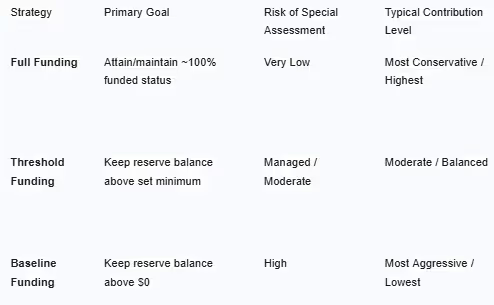
Metric 2: Choosing a Funding Goal (Full, Threshold, or Baseline)
The study presents funding goals, defining acceptable risk levels :
- Baseline Funding: Keeps balance just above $0. High risk, rarely recommended.
- Full Funding: Aims for ~100% funded. Low risk, most conservative.
- Threshold Funding: Keeps balance above a set minimum (e.g., 70%). Balanced, commonly recommended.
How to Implement a Reserve Study: A 5-Step Guide for South Dakota Boards
For a South Dakota board implementing its first study, the process involves these steps :
Step 1: Understand the 3 Levels of a Reserve Study
Know what to ask for. National standards define three levels :
- Level I (Full Study): The essential first study. Involves full on-site inspection and inventory creation.
- Level II (Update with Site Visit): Periodic update (every 3-5 years recommended), specialist verifies inventory and re-assesses conditions on-site.
- Level III (Update, No Site Visit): Financial-only update for off-years.
Step 2: Pass a Board Resolution and Prepare Documents
Formally resolve to commission the study. Gather essential documents: Governing Documents (defining maintenance responsibilities), budgets, and repair records.
Step 3: How to Hire a Credentialed Reserve Specialist
This is critical. Perform due diligence. Look for :
- Credentials: RS (Reserve Specialist) from CAI or PRA (Professional Reserve Analyst) from APRA. These require experience and adherence to standards.
- Standards: Adherence to CAI National Reserve Study Standards.
- Insurance: Proof of professional liability (Errors & Omissions) insurance.
Step 4: The Kick-Off Meeting and On-Site Inspection
Schedule a kickoff meeting and the on-site inspection. Ensure someone knowledgeable accompanies the specialist. This is the "Physical Analysis".
Step 5: Review the Draft Report and Adopt the Funding Plan
Review the draft for factual errors. Formally vote to adopt the study and, most importantly, implement its funding plan into the next annual budget. This action documents the board's fulfillment of its fiduciary duty.
Conclusion: Why a Reserve Study is a Critical Investment for Your South Dakota Community
For a South Dakota HOA or condo board, commissioning a reserve study is not about complying with a non-existent state law. It is about fulfilling your fundamental fiduciary duty to manage the association's assets prudently.
In South Dakota, the reserve study is the mechanism that:
- Fulfills the board's "prudent person" Duty of Care.
- Protects homeowners from unfair and potentially challengeable special assessments.
- Preserves and enhances property values.
- Helps meet lender requirements.
- Provides objective justification for budget decisions.
A South Dakota board that proactively commissions a reserve study demonstrates responsible management and takes the most critical step toward securing a stable financial future and mitigating personal liability for volunteer directors.
Last updated:
Not legal advice. This guide is general information about reserve requirements and is not a legal recommendation. Laws and lender rules change, and how they apply depends on your association's governing documents and circumstances. For the most up-to-date requirements, check your state's official website or consult an HOA attorney.