
Many HOA/COA budgets are “balanced” only because the Board is hoping three things hold: nothing breaks, owners pay on time, and the reserve study is still accurate. That’s not a strategy; it’s a risk posture.
Late-winter conditions are when hope budgets get stress-tested. In much of the U.S., the coldest time of year clusters in January, increasing freeze-driven failures and exposing deferred maintenance. At the same time, Boards that are underfunded or operating with outdated assumptions often discover that projects can’t start, costs have escalated, and homeowners no longer trust the numbers.
When that happens, boards frequently fall back on special assessments or loans, which is the exact outcome reserve planning is meant to minimize.
Why HOA/COA budgets drift into “hope”
Boards rarely choose chaos. More often, chaos is baked in through a few predictable budgeting pitfalls:
Treating the reserve study like a static PDF. When a study sits unchanged while costs, component condition, and actual project timing change, the budget quietly stops reflecting reality.
“Last year + X%” budgeting without a project schedule. If you don’t have a project list with timing, scope, and cost ranges, you’re not budgeting. You’re just guessing. A reserve study should start with a component inventory and translate it into a funding plan.
Ignoring inflation (or applying a single flat inflation rate to everything). Inflation doesn’t hit every component equally, and timing matters: when a project slips, the cost is often higher when it restarts. Reserve planning guidance warns that relying on old reserve recommendations without inflationary adjustments is a common failure mode.
Underestimating the impact of delinquencies and late payments on cash flow. Many homeowners view assessments as “just right” or “too little,” and most support enforcing payment, yet cash-flow stress still happens when accounts fall behind. Your association’s health depends on timely collection, and high delinquencies force other owners to cover shortfalls and can undermine reserves.
Why projects stall, costs escalate, and trust unravels
What happens when a much-needed project falls behind schedule? The dreaded special assessment. This is when Boards must make waves amongst their homeowners to garner approval for an oftentimes expensive project that goes beyond the initial assessments determined by the Board. Special assessments aren’t only a financial event, but a trust event. And worst of all? The association can still vote no. Here are some common stalling points:
Unclear scope + unclear math. Owners don’t vote “no” because they love deterioration; they vote “no” when they don’t understand what they’re buying, when the Board can’t show how the number was built, or when the timeline feels improvised. The trust problem is usually a data problem first.
“We’ll revisit it next year.” Underfunding guidance is explicit: delayed projects tend to get more expensive and more complex. Every deferral adds inflation exposure, increases the chance of collateral damage, and decreases the credibility of future estimates.
Approval requirements and quorum realities. According to the Community Associations Institute, 31 states and Washington, DC have statutory requirements relating to the imposition of special assessments, collection, and regular increases, so process mistakes can invalidate (or delay) funding. What’s more, in safety-threatening emergencies, Boards may need authority to impose special assessments or borrow without a membership vote, implying that many non-emergency situations can be constrained by member-approval rules or governing documents.
Trust erosion compounds operational risk. The moment owners suspect the Board is “guessing,” every line item becomes a debate, and the association loses time. That’s the one resource you can’t replenish during winter failures.
Data-driven solutions Boards can implement now
A “data budget” doesn’t mean complex. It means auditable: a homeowner (or lender) can follow the logic from asset condition → project scope → timing → cost → funding plan → owner impact. Here are a few ways Boards can choose data over hope in their financial planning:
Adopt a “living reserve” approach. By using live data instead of outdated PDFs, Boards can:
- update project timing when work is deferred or accelerated,
- refresh costs as pricing changes,
- track actual spending against forecast, and
- document decisions so the story stays consistent across board turnover.
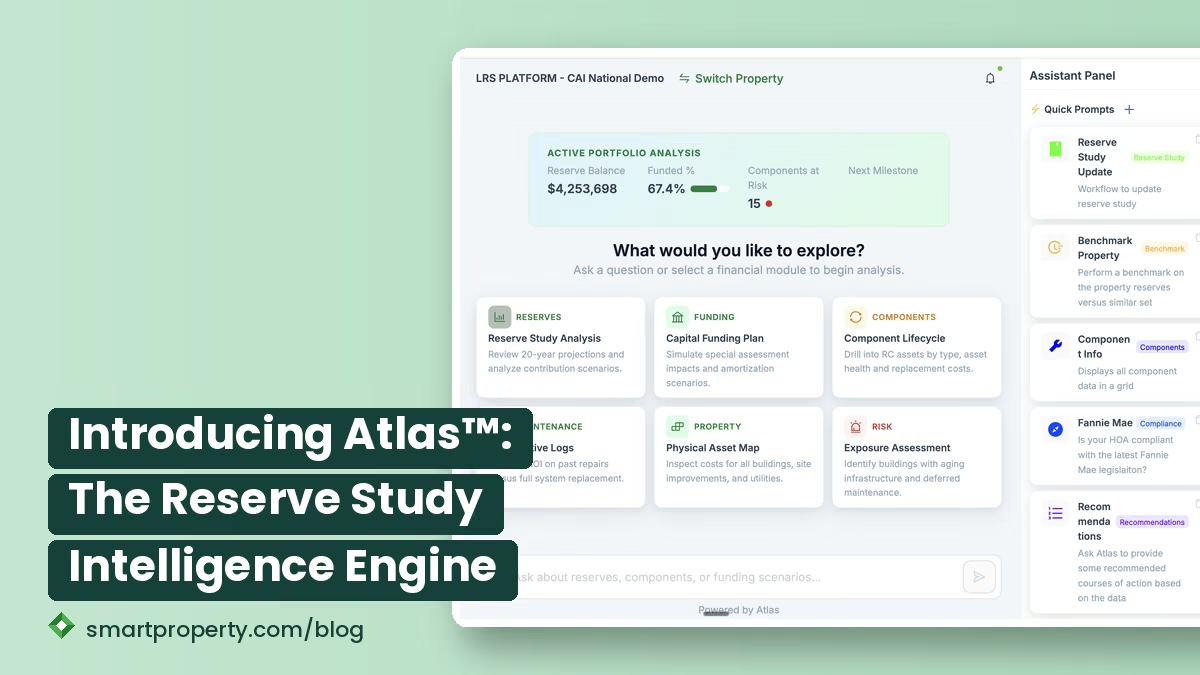
SmartProperty’s Living Reserve Study® is a real‑time updatable document tied to projects, costs, and schedules, reducing reliance on disconnected spreadsheets and improving homeowner education through visibility into “why” a component is scheduled.
Static Reserve Study vs Living Reserve Study
| Attribute | Static Reserve Study | Living Reserve Study |
|---|---|---|
| Update frequency | Periodic (often every 3–5 years; sometimes longer) | Continuous or frequent (as conditions/costs change) |
| Inflation adjustment | Often based on assumptions set at the time of the report | Updated as pricing changes; can vary by project/category |
| Project linkage | Schedule exists, but often disconnected from real execution | Reserve plan tied directly to project planning and execution |
| Transparency | PDF/report shared intermittently | Ongoing visibility into assumptions, notes, and changes |
| Cost-tracking | Actuals tracked elsewhere (spreadsheets/accounting) | Actuals can be compared to forecasts at project level |
| Homeowner visibility | Typically summary-level unless owners request full report | Designed for ongoing homeowner education and "why" clarity |
| Risk reduction | Depends on how often it's refreshed and used | Designed to reduce surprise gaps via continual alignment |
Build a project-level financial roadmap (the missing middle). Most Boards communicate either too high-level (“we need money”) or too technical (a 60‑page reserve PDF). The roadmap is the bridge:
- Project sheet per major component: scope, timing window, risk if delayed, comparable past costs, financing options.
- Funding model: reserves + operating + (if needed) short special assessment tied to a defined project.
- Scenario test: “Do it now vs delay 12 months” so owners can see the cost of waiting.
This is exactly the type of “what‑if” analysis and live forecasting made possible through SmartProperty, where Boards can use a living component inventory to adjust strategies and potentially reduce unnecessary increases while maintaining overall financial health.
Use lender/agency criteria as a neutral external anchor. Instead of making it a board-versus-owner debate, frame reserve contributions and delinquency reduction as protecting owners’ financing options and marketability. HUD and Fannie Mae criteria provide concrete benchmarks (10% reserve funding, 15% delinquency thresholds) that owners can recognize as external reality—not board preference.
Communicate techniques. Lead with the “why now” before introducing the dollar figure so the context supports the number. Show a simple one-page visual connecting project timing, funding source, and monthly homeowner impact to reduce uncertainty and increase clarity. Publish clear decision rules explaining what triggers a special assessment versus a reserve draw or phased approach. Reinforce the same narrative across emails, meeting decks, FAQs, and vote notices so the message stays consistent and credible.
Hope Is Not a Funding Plan
When reserve assumptions are outdated, inflation is ignored, and project timing drifts without recalibration, the outcome is rarely smooth. It’s stalled work, rising bids, frustrated homeowners, and the pressure cooker of a special assessment that may or may not pass.
Data-driven budgeting changes everything. Instead of reacting to failure, Boards can show a clear line from asset condition to funding strategy. Instead of defending a number, they can demonstrate the math. Instead of debating emotion, they can anchor decisions in documented assumptions, lender criteria, and transparent forecasting.
Few moments test a Community Manager like a special assessment. Projects stall, costs soar, trust unravels, and sometimes, after all that effort, the vote still fails. But special assessments don’t start with a vote; they start years earlier with assumptions that were never revisited.
The shift is simple in principle: move from static to living data, from “last year plus X%” to project-level forecasting, from reactive explanations to proactive roadmaps. When homeowners can see the logic, and when the story behind the spend is clear, opposition softens and alignment strengthens.
Hope is not a strategy. Visibility is. And Boards that choose data today are far less likely to face emergency funding tomorrow.